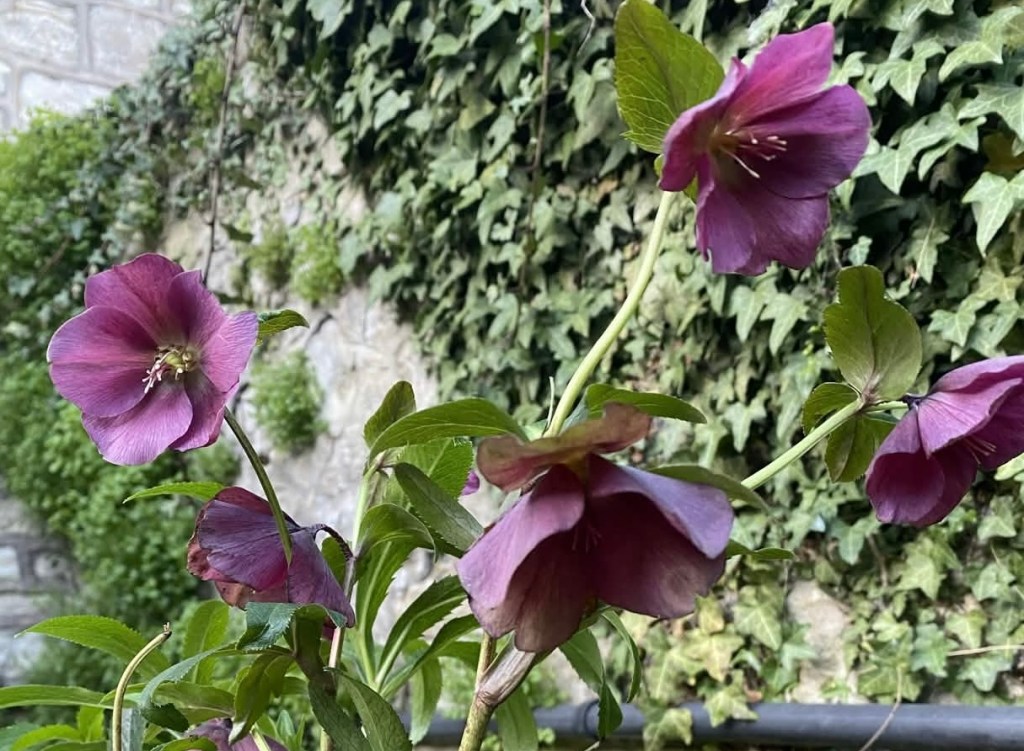
Hellebore, you are my Rose of Sharon,
The door of silence is opened
Creation shall dance forth from
perfection’s lips,
It has cracked our faces and hearts of Stone,
The sweetness of this joy is, is not, the
eternal manna.
Amen, twice Amen, we are, we are not,
We are one, we are not.
In your suffering, you need no healing,
All is perfect unto a dance of glory
unto god.
— ANDREW D. CHUMBLEY
Stultus, 1985
Hellebore has long been infamous for its powerful toxicity. One notable example appears during the Siege of Kirrha in 585 BC, when Greek besiegers are said to have poisoned the city’s water supply with hellebore before assaulting the city. Yet, despite its deadly reputation, the plant carries strong mythological and historical associations with the treatment of madness—a remedy potent enough to counter even afflictions imposed by divine wrath. In myth, Melampus of Pylos used hellebore to cure the daughters of the king of Argos after they were driven mad by Dionysus. Likewise, hellebore was associated with the remedy for the madness that overcame Heracles, a frenzy sent upon him by Hera that led to Heracles killing his children. I recommend reading the articles titled The Court Of Helleborus: A Collection Of Hellebore Lore by Coby Michael Ward, The Christmas Rose: The Myth and Magic of the Black Hellebore by Icy Sedgwick, and Kitchen Toad/Mahigan’s A Primer of Stellar Wortcunning: Seeing Through the Gorgon’s Tears for an introduction on the science, folklore and history of the hellebore plant.
Rather than focusing on hellebore’s malefic qualities, I instead am drawn to explore its capabilities as a herb of exorcism, a protector from plague and evil spirits, and a bestower of inspiration.
The herb, which blooms even in the cold of winter, is a violent purgative. Humoral pharmacology classified hellebore as a ‘melanagogue’, a substance associated with melancholy (a term originating from the Greek melancholia, literally ‘black bile’). Physicians of ancient times understood black bile as a dark, viscous, foul-smelling bodily fluid generated in the spleen. They believed that many mental disorders arose when a disordered spleen produced this substance in excess, causing it to spill into the stomach and send vapours upward through the alimentary canal, where they were thought to ‘darken the mind’ and ‘over-cloud the brain’. Within this framework, hellebore acquired a reputation for sharpening the intellect and dispelling melancholy (what might now be compared to conditions such as depression or anxiety) because it provoked a violent evacuation of the stomach and intestines. Ergo, by compelling sufferers to ‘vomit out their follies’, the hellebore’s purgative nature has been viewed akin to an exorcism of bad spirits.
Just as a poison may, in the proper dose, function as a medicine, hellebore was understood to heal precisely because it also possessed the power to harm. In other words, curative potential derived from the same qualities that made it dangerous. As Carl Ruck observes in The Myth of the Lernaean Hydra, ‘[…] the only cure for intoxicated madness was the same toxin that induced the madness.’ To extend this logic further, it can be inferred that it was precisely hellebore’s capacity to inflict harm and sickness that was thought to enable its protection against disease and pestilence. According to Herbal Lore in Central and Eastern European Shamanic Traditions by Henry Dosedla, in Alpine regions, records describe the use of ‘bath-cabins’—comparable to saunas—as sites for promoting health through aromatic herbal bathing, with hellebore being among the plants employed. Likewise, Alpine folklore believes that carrying a piece of hellebore root in one’s pocket was thought to protect the bearer from various forms of evil. Daniel Schulke’s Viridarium Umbris: the Pleasure Garden of Shadow and The Green Mysteries: Arcana Viridia similarly noted that during the Middle Ages, hellebore root (carved in a form reminiscent of a mandrake’s alruan) also appeared in anti-plague charms. Additionally, Dioscorides noted that hellebore scattered about the house can protect the household from evil, much like the Elizabethan folklore whereupon hellebores were planted near doorways due to its power to repel evil spirits.
All of this made me think of how Apollo, who presides over all music and songs and dance and poetry, is as much a god of disease as he is a god of healing. The sun-god delivered people from epidemics, yet he could also bring ill health and deadly plague with his arrows. This is much akin to the hellebore, whose poison could induce diarrhea and dizziness and delirium and worse, potentially leading to fatal heart failure, yet it held the potential to purge and heal and protect. Additionally, the cult of Apollo is also known for their connection to the cult of the Muses, for Apollo is a frequent companion of the Muses who often functions as their chorus leader in celebrations.
Building upon this, it is my gnosis that the hellebore, despite—or because of—its associations with madness, is capable of bestowing inspiration much like the Muses do. But, before I expand more on that statement, I wish to provide some additional context.
First, is the idea that art and possession are inextricably linked. I highly recommend people read Vanessa Irena’s article, the artist is possessed, for a more in depth exploration of this. In The Idea of Poetic Inspiration in the Eighteenth Century by Lillian Bean, which quotes the works of Plato, it is stated that ‘all good poets, epic as well as lyric, compose their beautiful poems not as work of art, but because they are inspired and possessed […] for the poet is a light and winged and holy thing, and there is no invention in him until he has been inspired and is out of his senses, and the mind is no longer in him: when he has not attained this state, he is powerless and is unable to utter his oracles—for not by art does the poet sing but by power divine.’ Exorcism is the opposite of possession. Yet, just as it is because something is capable of harming that it can heal, I believe that it is because the hellebore’s capabilities for exorcism comes from its ability to possess. And what is to be inspired but to be possessed? What is to be out of your senses, your mind no longer yours, but to be mad?
Hellebore is thus the herb of exorcism and possession, of madness and inspiration both.
Secondly, I wish to discuss hellebore’s astrological rulerships. In Agrippa’s Three Books of Occult Philosophy, hellebore is associated with Mars and Saturn. Yet, despite Mars’ association with violence and conflict, it can be argued that Mars is also constructive. Caleb J. McCoy writes of how Mars rules ‘those who work with their hands’. That Mars ‘manifests in smithcraft, masonry, carpentry’ and more. I would go further and assert that, more than constructive, Mars is creative. Mars is the fire of the forge of creation. Mars is the fire of inspiration, the flame between the two horns of the Devil that brings either madness or gnosis. Hence, it is not absurd that hellebore can be a herb of creativity and creation as much as it risks bringing sickness and self-destruction.
Finally, I would also point out how the practice of transforming poison into medicine is a practice prevalent in cultures worldwide—and it is, in my opinion, a martial practice. One example exists in Buddhist traditions, such as that of Nichiren Buddhism which focuses on the concept of hendoku-iyaku: the principle that the poison of earthly desires and suffering can be transformed into benefit and enlightenment, comparing the Lotus Sutra to ‘a great physician who can change poison into medicine’. Similarly, in the Mahayana text The Wheel of Sharp Weapons, the text speaks of how peacocks consume poisonous plants and thrive off those poisons, implicitly transforming poison into beauty via the beauty of their plumage.
‘In jungles of poisonous plants strut the peacocks / Though medicine gardens of beauty lie near. / The masses of peacocks do not find gardens pleasant, / But thrive on the essence of poisonous plants […] And thus Bodhisattvas are likened to peacocks: / They live on delusions-those poisonous plants. / Transforming them into the essence of practice’
I find it fascinating to note that the peacock is a bird that is both jovian, venusian and martial in nature. Skanda, the Hindu god of war, rides upon a peacock. Skanda is also the god of illnesses. It brings to mind how intertwined poison and sickness and medicine can be, how poison can be transformed into something beneficial via creativity—which brings us back to the discussion regarding why hellebore, the poison plant, is also a muse and bestower of creative inspiration.
Ruck writes that hellebore ‘induces delusionary visions’ which was ‘sometimes interpreted as artistic inspiration’. Schulke writes that the black hellebore possessed a ‘deific form’ in the form of the ‘Muses’. Congruently, he writes that the emblem of the black hellebore (whose name, despite its white flowers, comes from the fact that its roots are black) is that of an ‘ecstatic poet inscrib[ing] words on parchment, counseled by a devil, who whispers in her ear.’ I would also point out that this connection of the hellebore to the Muses also occurs in how Mount Helicon, the home of the nine Muses, was mentioned by Pliny as being where one can find the ‘best’ hellebore.
Is this mere accident that the mountain of the Muses should also be the place where the finest hellebore grows? Can it be coincidence that the herb so bound to danger and madness should take root upon the same ground sacred to song and poetry? I think not, for what is the Muse’s touch, if not an intrusion upon the mind, a force that displaces the self so that something other may speak through it? If Helicon is the abode of those powers that loosen the tongue into prophecy and verse, then perhaps it is only fitting that hellebore should flourish there also, as a botanical counterpart to that same ecstatic condition. Hellebore reminds us that art is never safe, that vision has always existed perilously close to madness.
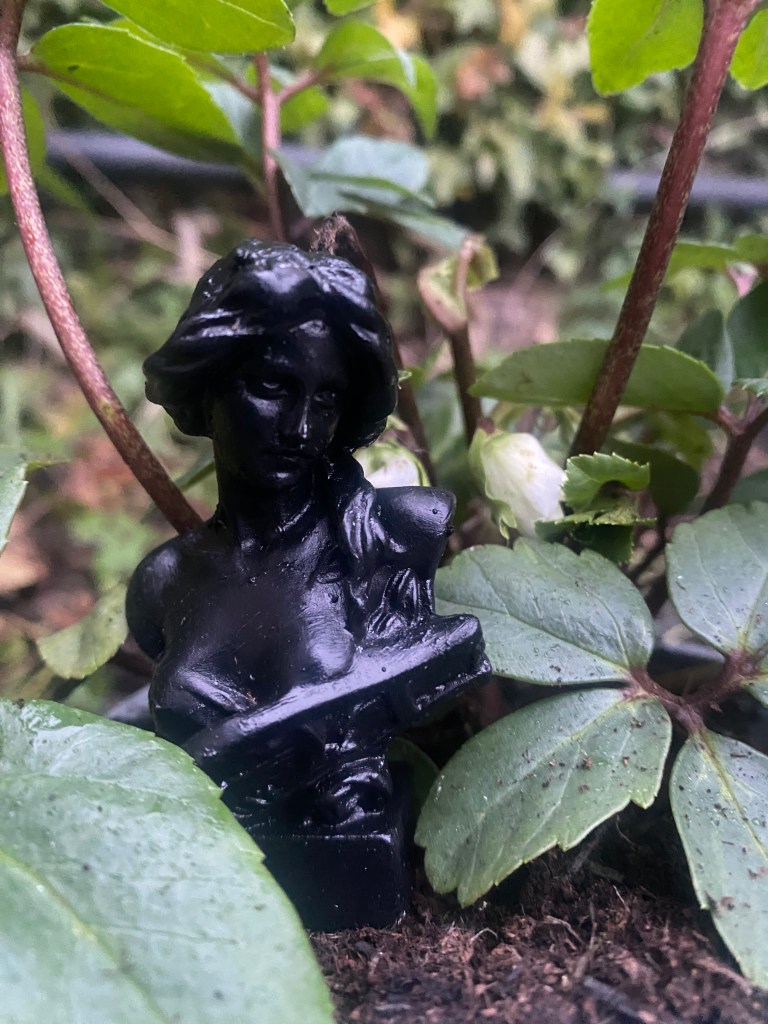
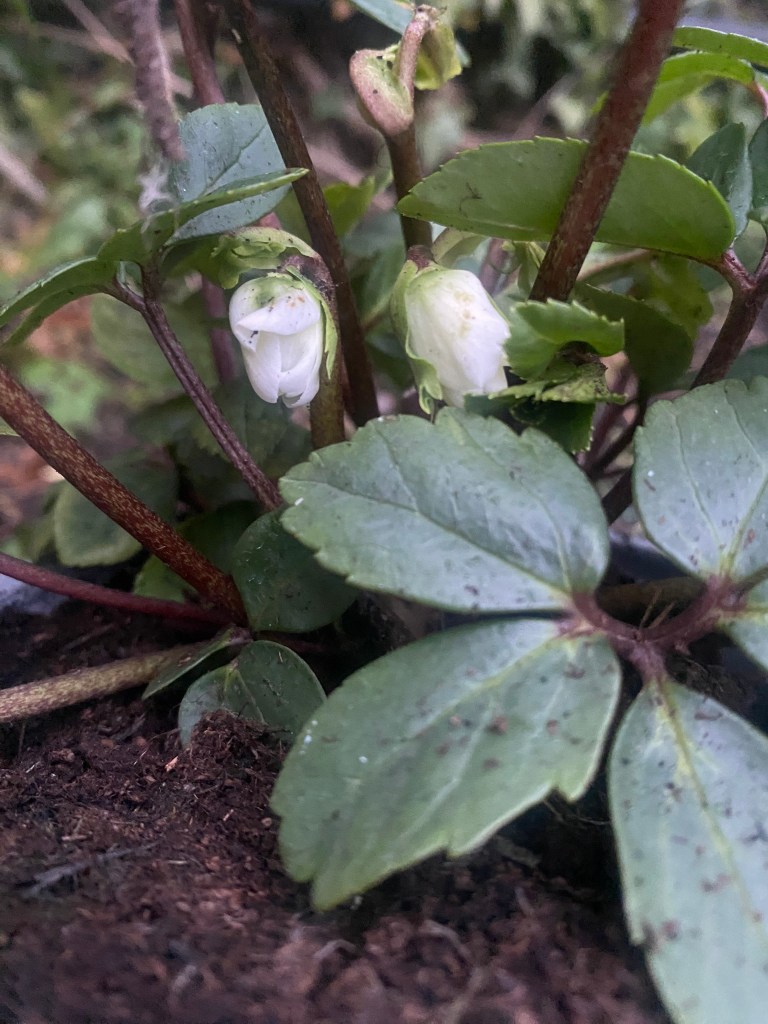
So, when—a day after I brought my hellebore plant home—I found a miniature statue of the muse Calliope unused in my partner’s office, I asked my partner if I could have the statue and decided to turn this statue into a devotional item dedicated to the hellebore. I painted the statue black to allude to the black roots of the black hellebore, and painted upon it the Cross-Seal of the Devil of Poison (a seal associated with hellebore) taken from the Viridarium Umbris. The statue is to be seated among the hellebore flowerbed and, in the future, I would like to ensoul the statue by placing hellebore root and flowers inside the statue, essentially using the statue as a spirit house for the spirit of hellebore.
Moreover, aside from hellebore’s aforementioned capabilities, I also believe hellebore could potentially be utilized as an ally of curse-breaking and reversal magic.
In Homer’s Odyssey, Odysseus and his men arrive on Circe’s island, Aeaea, where the sorceress Circe lures his crew into her hall, drugs them, and transforms them into swine, though they retain their human minds. When Odysseus goes to rescue them, Hermes intercepts him and gives him the magical herb moly—described as having a black root and white flower—which protects him from Circe’s spell. Thus, when Circe offers him the same enchanted drink, her magic fails, and Odysseus draws his sword, forcing her to yield, swear not to harm him, and restore his men to human form. In the paper Hermes’ Herb: Homer’s Moly and Early Modern Iatrophilology by Benjamin Wallura, it is argued that the herb moly might refer to the black hellebore, due to both its appearance (white flower, black roots) and ability to clear the mind and strengthen one’s wits. Thus, just as the moly has aided Odysseus in protecting himself and freeing his men from Circe’s curse, the black hellebore may too possess virtues of curse-breaking and protection from curses and enchantments.
Furthermore, in Tools of Avernus by S. Aldernay, it is claimed that ‘Hellebore has the great power of reversal, any plant it comes into contact with will have its properties reversed’. Because of this, I am curious to explore how the hellebore may be an ally in reversal magic. According to Old Style Conjure: Hoodoo, Rootwork and Folk Magic by Starr Casas, in Hoodoo practices, a reversal (sometimes called return-to-sender) is defined as ‘a set of works that can be done to turn a situation around’. For example, if you experienced a run of bad luck and nothing you have done has changed it, you might need to do a ‘set of reversal works to remove whatever is there, and if someone caused your bad luck, they will get it right back’. Austin Fuller has also written a very comprehensive blog post on this topic, titled Reversal Spells & Workings, which I recommend reading. It would be curious to experiment around with utilizing the hellebore in reversal workings, such as using hellebore as an ingredient in reversal oils, or washing reversal mirrors with hellebore-infused water.
I am also aware of hellebore’s astrological association with the fixed star Algol, and how Algol is known too for its protective qualities. It might be fun to recreate a version of Sphere and Sundry’s Drakontomalloi oil (which I have used years ago, back when I was in an abusive situation and in need of protection) utilizing hellebore as a base. The oil is described to be ‘[…] a protection oil that defends you by striking terror into those who would do you harm; it will hone your wrath, your anguish, and your fury into a blackened, hissing shield that deflects any malicious intent. This oil utilizes pure, unmitigated fear to protect you from your enemies […] a chorus of screams of primordial rage, this is a stony primeval bulwark that defends against curses.’ I believe hellebore, for reasons aforementioned, holds great potential to be a powerful protector.
All things considered, I would like to end this post with a few disclaimers. I must emphasize the very literal dangers of handling the hellebore: all parts of the plant are toxic if ingested. This is applicable to humans, cats, dogs, rabbits, pigs, cows, goats and most other household pet species. Hellebore, like other plants in the buttercup family, can act phototoxic and cause severe skin irritations after touching the leaves, sepals or flower stems of a hellebore plant. Be very careful if one wishes to use hellebore in a wash, or infuse it in tinctures or oils, and I would be personally wary of burning it or smelling its fumes. Treat the plant with reverence, for there are ways to commune with poison plants without having to recklessly consume it.
Likewise, I would like to make it clear that I do not condone the romanization or glamorization of mental illness, or using poison plants in place of pharmaceutical medicine. Speaking as someone who—after an experience with Mars which led to me being prescribed medication—has been taking anti-depressants for about half a year now, I have found that medication has contributed to me being more focused and calm in my day-to-day life, less prone to panic or depressive episodes, and more able to swiftly recover from periods of melancholy. In no way does medication make one a lesser witch or magical practitioner. It does not, in my experience, hinder trance states or communion/communication with spirits. I am also not encouraging the usage of poison plants in lieu of pharmaceutical medicine, nor am I qualified to make such a statement.
I find the following quote from The Witching Herbs by Harold Roth to be very wise and worth heeding: ‘you need to be cautious, not frightened. If you are fearful of a plant, don’t work with it. Mushroom gatherers know that fear can exacerbate a reaction to a poisonous mushroom. I think the same applies to the baneful herbs. If a potentially harmful herb makes you feel uncomfortable, don’t work with it; just learn about it from books and the experiences of others. Gradually, you can decide whether you want to go further. That said, there is no requirement for any witch to work with baneful plants. You can work with the rose for the rest of your magical life and not be any less of a witch than someone who has buckets of belladonna and wolfsbane around.’
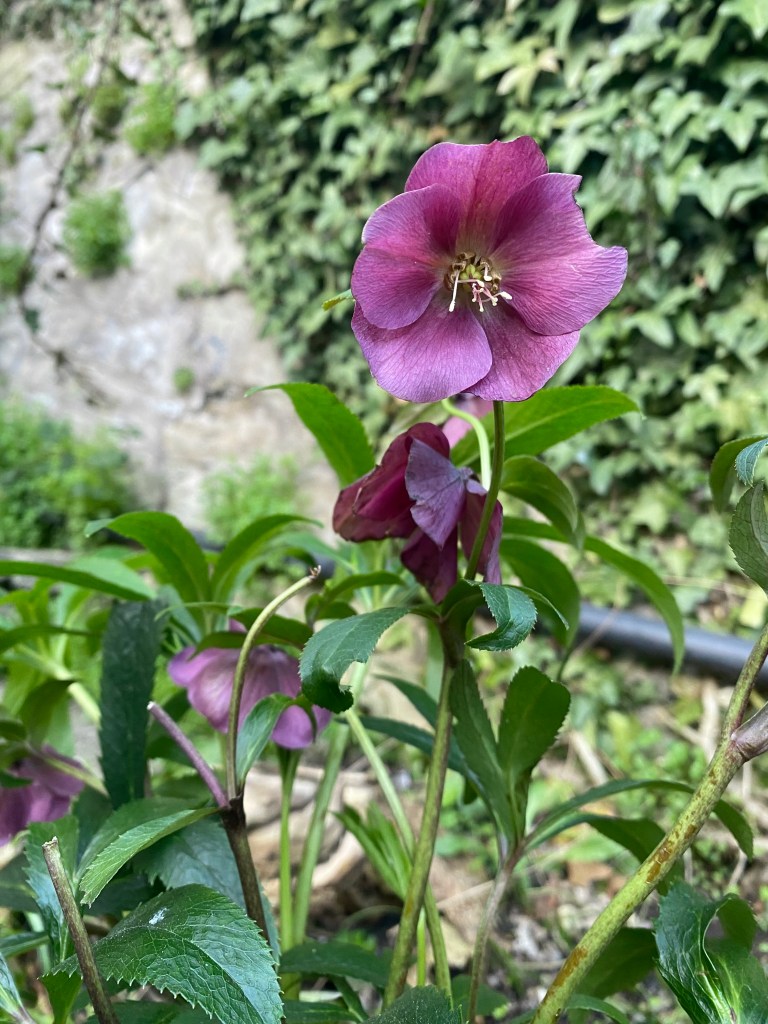
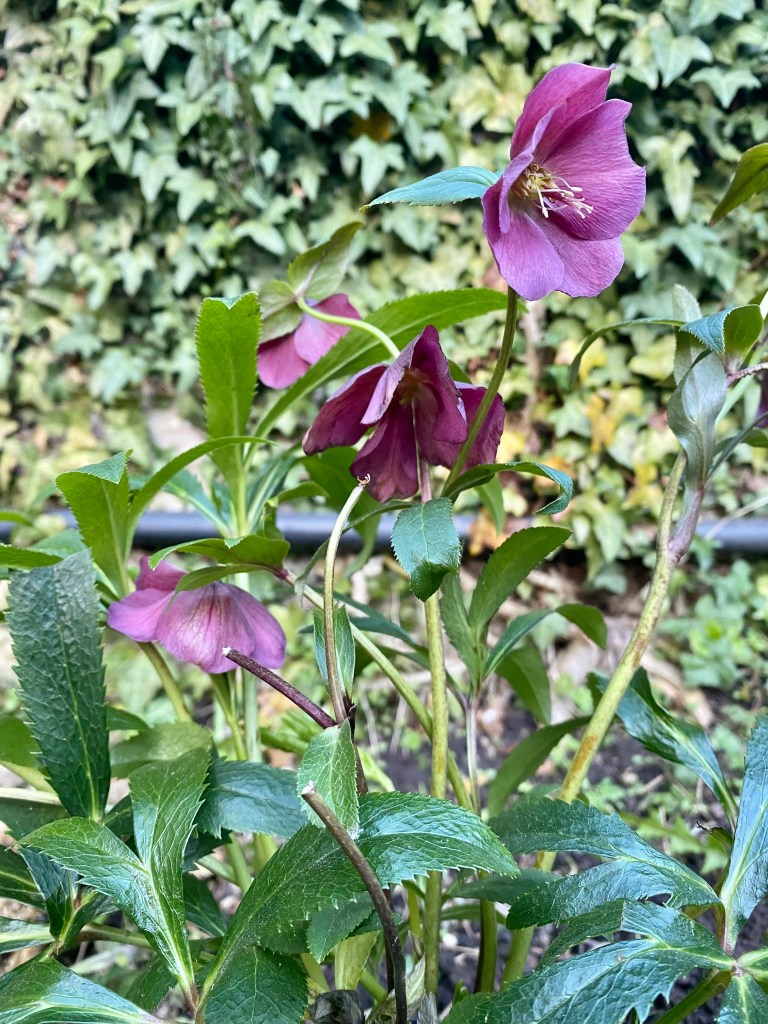
If you do not feel ready to work with poison plants, there is no rush to do so—if ever. I, personally, have never planned to engage with the hellebore until recently when I stumbled upon the hellebore in bloom in my city and was stunned by its beauty. That, and I believe that it felt like the right time, in light of how I am in my Mercury profection year, which means that fixed stars Aculeus and Acumen are activated in my chart (those two stars being the stinger stars of the constellation Scorpio, associated with poison). I also received omens from Alphard and Antares both regarding the hellebore. Moreover, I believe after paying respects to the hellebore and communicating with it, I also received a ‘name’ for the spirit of hellebore that I could use to refer to the plant, in order to access certain facets of its nature—Hellebore as the Muse-Angel—akin to how deities may have different godly epithets that allows one to access different faces of the deity.
So, a fun experiment to do with any plants you may be interested in working with: ask the plant ‘what name or title may I call you by?’ and see what it tells you.
Bibliography
- The Idea of Poetic Inspiration in the Eighteenth Century by Lillian Bean
- Herbal Lore in Central and Eastern European Shamanic Traditions by Henry Dosedla
- The Myth of the Lernaean Hydra by Carl Ruck
- Hermes’ Herb: Homer’s Moly and Early Modern Iatrophilology by Benjamin Wallura
- Tools of Avernus by S. Aldernay
- Viridarium Umbris: the Pleasure Garden of Shadow by Daniel Schulke
- The Green Mysteries: Arcana Viridia by Daniel Schulke
- ‘That They May Vomit Out Their Folly’: The Gut-Mind Axis and Hellebore in Early Modern England by M. Walkden
- The Wheel of Sharp Weapons by Dharmaraksita
- The Witching Herbs by Harold Roth
- Old Style Conjure: Hoodoo, Rootwork and Folk Magic by Starr Casas
- https://www.nichirenlibrary.org/en/dic/Content/C/26
- https://en.wikisource.org/wiki/1911_Encyclopædia_Britannica/Hellebore
 Upon the Altar