For some context, back in December 2024, I performed a modified version of the Conjuration of the Fifteenth Letter, calling upon the Sabbatic Orion-Sah. Without going into detail, the rite was not what I expected, due to my own underpreparation and certain mistakes I made during the conjuration. Still, I did receive from the ritual an arrowhead I can use as a talisman to steer me into taking right actions, among other usage. Nevertheless, I ended up pausing my practice with the Azoëtia for half a year, and it is only now that I’m slowly easing myself back into the swing of things, having felt pulled to work once more with the Tenth Letter of the Azoëtia.
CHUAYLIL: GENII OF THE TENTH HOLY LETTER
Over a year ago, in May 2024, I felt drawn to work with the Tenth Letter of the Azoëtia and ended up experimentally creating a fetish-object to act as a vessel for Chuaylil, the star-daimon of the Tenth Letter.
To put it simply, Chuaylil is the daimon of the Arthame—the Witches’ Knife, also called ‘The Blood-Letter’. The arthame (spelled ad’hame and arthame in the rather than the usual athame) is a tool of many functions, from command and compulsion to cutting and exorcising, and more. Chuaylil is one whose ‘Tongue is the Serpent within the Blade of the Arthame, and whose Body dwelleth in the Hilt’. Among his many powers, he is said to command ‘the Invisible Tides betwixt the Stars, the flow of Ichor within the Veins of the Gods, and the motion of the Blood within the Veins of Mortal Flesh.’
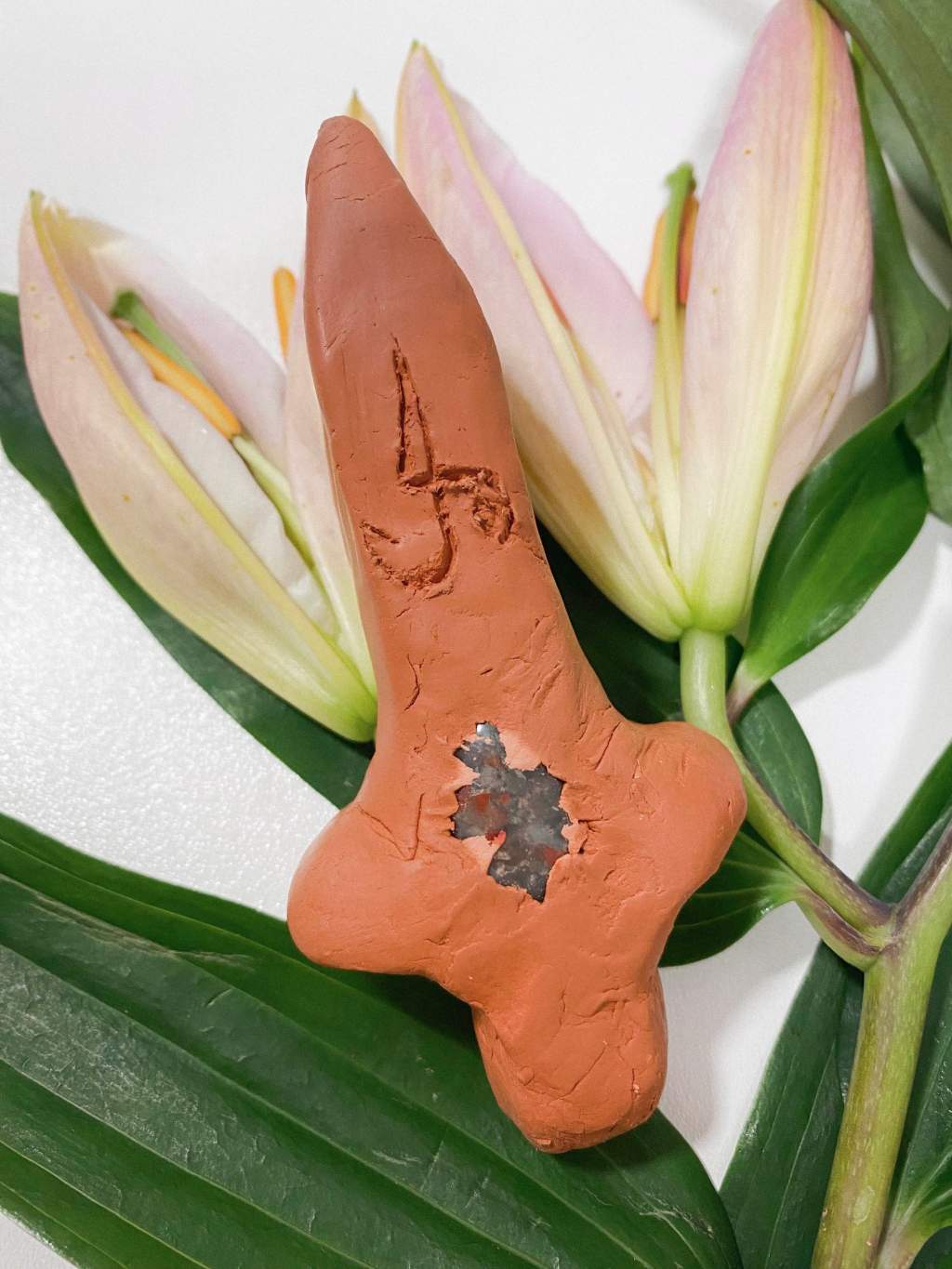
The fetish is made from a bloodstone and red clay, crafted into the shape of a dagger. I then fed the dagger some red wine, which has been infused with the essence of seven different sacrifices, some more literal than others (i.e. blood) and others more symbolic (ashes of a photo of myself when I was young, to represent the sacrifice of the ‘Innocent Babe’ as described in the text etc).
One may assume that Chuaylil, in his stellar aspect (for he is interestingly called a ‘Star-god’), is related to stars such as Capulus (the sword hand of Perseus) or Ensis (the sword-sheath of Orion), due to its nature as a blade. However, the Azoëtia instead connects Chuaylil and, by extension, the Tenth Letter to the constellation Gemini. Firstly, the conjuration of the Tenth Holy Letter mentions the sacrifice of the twins as being integral to the propitiation and invocation of the ‘Powers of the Geminus’, in order for the practitioner to ‘employ the Gateway as a Point of Mediation for those Powers and Entities existing in the Spaces Between’. This is, as aforementioned, akin to how Chuaylil is said to command the ‘Invisible Tides betwixt the Stars’—the powers of liminality, of what is betwixt and between.
Moreover, Chuaylil is said to be the one ‘who appeaseth the thirst of the Blessed and the Wise’, who ‘tendeth unto the Enthroned Ones within the Great Double House.’ In the Azoëtia, the Left-Hand Palace of the Great Double House is suggested to be symbolic of the seven stars of Ursa Major (Khepesh) whilst the Right-hand Palace of the Great Double House is that of the stars of Orion (Sah). Between them, if one looks at the night sky, is the constellation Gemini. More explicitly though, Azoëtia itself also names ‘Castor and Pollux’ who are the fixed stars of the Gemini constellation to be the ‘Twin-Pillars’ to the ‘Gate’.
Additionally, I suspect too that Chuaylil may have an affinity with the Crater constellation and the fixed stars Alkes, for Chuaylil is said to be the ‘Cup-Bearer’, the one who ‘beareth the Graal of the Sabbat’, who ‘catcheth the Fountains of Blood sprung from the Arthame’s Kiss, and who storeth the Powers thereof within the Invisible Sanctuaries of the Gods.’ Bernadette Brady delineates Alkes to be ‘linked to spiritual, mystical, and prophetic natures, to people who carry something symbolically precious for others’, befitting the title of Cup-Bearer, the one who bears the holy (or unholy) chalice. Ergo, the mysteries of blood and sacrifice and communion seems to be one that is under Chuaylil’s purview.
All of this to say, I believe that it is possible to engage with Chuaylil as being an entity with connections (or even allegiances) to the constellations such as Gemini and Crater. This is especially true when I realize that the third decan of Gemini is one that is associated with blades—both via associations to the Ten of Swords tarot card, and the decan itself being named ‘the Executioner’s Sword’ by Austin Coppock in his book 36 Faces.
THE WITCHES’ KNIFE: WHAT IS A BLADE ANYWAY?
A classic ceremonial knife can be used to open and close circles, to evoke and command and compel and, of course, to cut and curse and harm. But, there are all kinds of ritual blades and daggers and knives from different cultures. For example, the drigug of Vajrayana (the knives of the dakinis), the meed mor from Thai folk traditions (which literally means the [witch-]doctor’s knife) used for various purposes, from exorcising unruly ghosts to expelling spirits of sickness and disease from one’s limbs and body. There is also the trutmezzer of German folklore, which I wholeheartedly recommend people to read about via Frater Archer’s book, titled Trutmezzer: A Blade of Two Ways.
There are parts of Trutmezzer that reminds me eerily of Chuaylil:
“[…] suddenly we see the sword as the Scythians saw it: as the living body of God Himself who wanted to be fed and nourished and strengthened. Yet, this was not a body in the confined human sense, not girded with skin and covered with hair, but a body that by its nature was much more akin to a spider’s web. Stretched out between realities and worlds, threads stretched between here and there and everywhere. And on these threads the voice of the god resonated, traveling across these threads from the depths of the mountains where the iron slumbered, through the forge, over the anvil, into the storm and rain around us, and across our skin, and through our open mouths into ourselves.
[…] now we behold the blade to be the tongue, the lip, the eye, the lid, and the body of the god itself. We place our hand on this blade and reach through it into the body of the god. We follow the siren-like song of the iron and travel across the threads of this spider-god into their own world, into their otherworld. The blade here is no longer an instrument, an In-order-to, a tool of everyday life or war. It has awakened into Thou. It has turned into the dwelling of spirits, into the entrance to the cave of the underworld, the gate at whose metal barrier we knock, naked, with a bowl full of blood and our own lives in our hands.”
Moreover, Frater Archer makes a point of how the ‘enthroned, bloodstained sword’ can be equated to the ‘axis mundi’, which I find fascinating. Likewise, another point Frater Archer eloquently makes is regarding ‘the blade as a key to an invisible lock’, which is poignant when considering Gemini’s relation to gateways and gates.
On the topic of gates and keys, I am also reminded somewhat humorously of how—bear with me here!—the fetish-object I created looked suspiciously like the Swordstone Key from the video game Elden Ring. It is, essentially, an item you need in the game to break seals upon certain statues in order to unlock areas, quests, and to further progress the game’s story. Ergo, it is a cute little item that is made from stone, is in the shape of a sword, and functions as a key.
One UPG I have regarding Castor and Pollux is how the stars and their spirits, for whatever reasons, really like to show up in video games. It was during my mentorship under JM Hamade that they made it click for me: that video games allow for the doubling of selves and worlds. When you play a game, you (the flesh-and-blood person) is sitting across a screen, controlling a double of yourself who exists in another world inside a screen. This ‘doubling’ is something integral to the mysteries of the Gemini twin stars, and gaming is something that is very close to the nature of Castor and Pollux anyway, due to the twins’ association with children and playfulness.
I also find myself thinking of Mehrune’s Razor for the Elder Scrolls series, a fictional blade capable of cutting intangible concepts. In the lore of the game, it is implied that Mankar Camoran used Mehrune’s Razor to cut his protonymic (essentially, his true name, the essence of his soul and being) to transform himself into someone who could wear the Amulet of Kings. Without diving too much into the convoluted lore of the game, the implication is that Mehrune’s Razor is a blade which can cut reality itself and transform one’s very nature into something greater. Soul surgery, if one may call it that.
It should be noted too that Michael Kirkbride, the game developer who wrote this lore, is (or at least was) an occultist, someone who proudly described himself to be a ‘gnostic heretic’ (and I believe a Thelemite too). And, with respect to Mehrune’s Razor and the process of cutting and changing one’s nymic, Kirkbride once wrote in an AMA to ‘think Hellraiser and you’re close’. This frankly made me cackle because Hellraiser is one media that my friend and colleague, Sasha Ravitch, have used as a framework to describe stellar witchcraft.
A part of me wonders if Chuaylil is capable of that too: cutting reality itself, whatever that means.
Regardless, I have rambled on enough. The key takeaways from this post is that:
- the witches’ knife is not merely a tool
- the arthame can be both a key to open invisible doors, a symbol of the axis mundi itself, and the body of god
- Chuaylil and the Tenth Holy Letter of the Azoëtia may potentially be connected to the Gemini constellation (and the twin stars Castor and Pollux), whose sacrifice grants access to liminal powers and the spaces between worlds.
 Upon the Altar