What was it that stayed my hand then?
Hunter by Paris Paloma
With dagger held unsheathed, blade pointing in its side
I’d been set upon by a predator
It was just looking for a meal, I saw ribs and fearful eyes
What is it that stays my hand now?
With so much misery that I could mercifully put ends to
For that animal I let slink off into the undergrowth, unscathed
Do I not fear death, but just pretend to?
Introduction
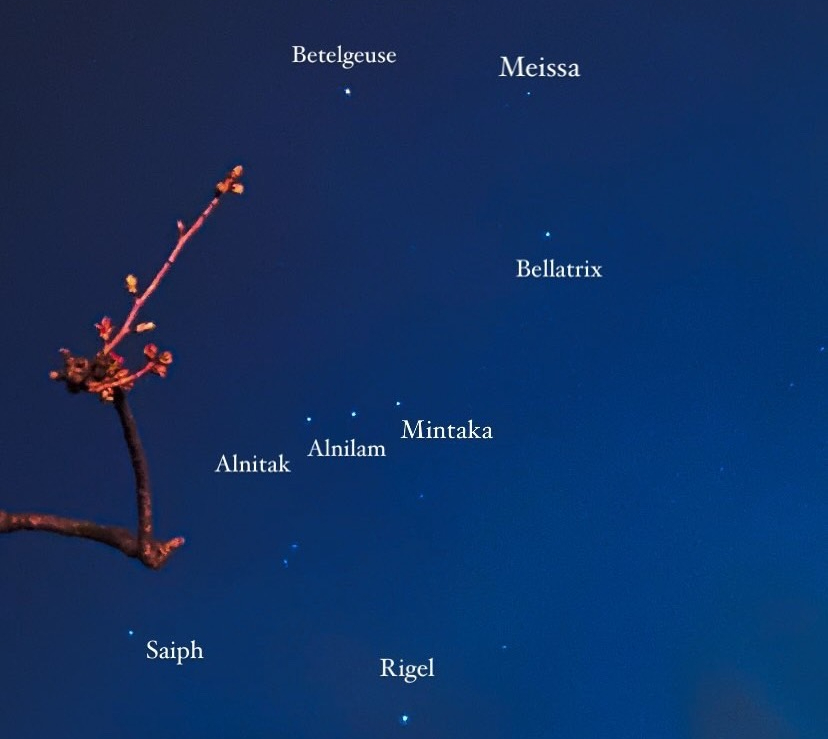
It was October 2022 when I first got my hands on a copy of the Sethos edition of the Azoëtia: A Grimoire of the Sabbatical Craft. It was about February 2023 when I first performed an astrolatry rite, based upon the Conjurations of the Fifteenth Letter, reaching out to Orion. I admittedly did not receive much of a discernible reply from the constellation— perhaps, it is due to the ‘incorrect’ timing or simply the silence was a mercy, sparing me from contact before I was ready. Regardless, in the year since then, I instead found myself developing a tangible relationship with the stars of Alderaban and the Pleiades instead. Those familiar with stellar folklore will understand why there is a connection of sorts between Orion and the Seven Sisters, and an affinity with Orion and Aldebaran. It shouldn’t have been a surprise to me that one day I would receive an opportunity to engage with Orion once more, should I choose to do so. This winter, I feel compelled to return to the Azoëtia, and multiple divinations on my part have confirmed the auspiciousness of re-engaging with Orion, if only to say ‘hi’ to the Great Hunter.
In truth, I find myself fearful of his hunter-aspect for reasons I will not get into. Rather, I find myself comforted and fascinated by another side of him that came with the realization that the bow is indeed the same as the scythe— Orion as a Lord of Death. Below will be a summary of an attempt to map out my understanding of Orion-Sah, as informed by UPG, and folklore, and mythos related to the sabbatic current.
The Great Hunter
Orion is first and foremost a hunter, he who wanders in the wild with bow and arrows, on the lookout for his quarry. In Thai folklore, I associated him very much with Praan Boon: a mythological figure commonly venerated in Southern Thailand. The term ‘Praan’ means hunter, and Praan Boon is sometimes colloquially referred to as Grandfather Boon as well. Praan Boon wears a mask of bright, crimson red and is known for hunting one of the seven kinnaree bird-women sisters, hence the parallel between the tale of Orion and the Pleiades. Yet, Praan Boon is as much a sorcerer as he is a hunter. Furthermore, it is said that he once saved the life of a naga lord by the name of Chompoochit, resulting in the naga lord taking Praan Boon to the naga underworld for seven days before returning him to the human world. Because of the favor he has gained, Praan Boon was able to be granted a serpent lasso—or a noose, some may say—from the naga lord. It was with this serpent noose that he captured the kinnaree.
I bring up this connection between Praan Boon and the nagas because, from a folkloric standpoint, the detail of the myth reveals a lot. The number seven is important—seven Pleiadean sisters, seven days in the naga underworld et cetera—and it reminds me of the myth of humans taken by the Fair Folk, such as Thomas the Rhymer who encountered the Queen of the Elphame and was made to spend seven years in her world, or how the Fair Folk have a tithes to hell that must be paid every seven years. This appears to be no accident, for the Fair Folk are very much associated with the Pleiades and, as I have come to learn, nagas are descended from the Pleiades as well. In Vedic folklore, there are seven sages known as the Saptarshi, associated with the seven stars of the Big Dipper / Ursa Major. One of these sages, Kashyapa, is the husband of Kadru—one of the six wives of the seven sages, the wives being the stars of the Pleiades. In other words, a star of the Big Dipper and a star of the Pleiades are husband and wife. Together with her husband, Kadru of the Pleiades is known to be the mother of nagas, birthing forth many great naga kings like Ananta Shesha and Vasuki. In other words, nagas are children of the Pleiades and Praan Boon is very much one who is favored by the nagas.
Just to make it clear though: I am NOT saying that nagas = fairies. I do not work with the Fair Folk nor do I wish to. I am only saying that nagas are Other-than-human and there is a significance to how Praan Boon (who, in my view, is the Thai interpretation of Orion) was taken and granted the favor of a class of serpentine spirits who also happened to be associated with the Pleiades, and how those tools he gained from those serpentine beings led him to (in my interpretation) capture another one of the sisters of the Pleiades later on.
Moreover, in Vedic astrology, the constellation of Orion is also known to be the lunar mansion of Mrigashīrsha which is associated very much with the deer. Aside from the commonly known myth of Mrigashīrsha and Rohini (which I’ll discuss later in relation to beheadment), my favorite myth related to Mrigashīrsha is one where Orion is depicted as a hunter perched atop a tree, waiting for his prey. When he spots a beautiful deer, he prepares to shoot, but the deer pleads with him to let her return home one last time to see her baby. Moved by her request and not expecting her to come back, the hunter agrees. While waiting in the tree, he unknowingly drops bilva leaves (bilva or bael leaves are considered sacred in Hinduism, especially in the worship of Lord Shiva) onto a Shiva linga (an abstract icon of worship of Shiva) below. To his astonishment, the deer keeps her promise and returns to face her fate, allowing the hunter to slay her. Impressed by the hunter’s accidental offering and the deer’s courage and integrity, Lord Shiva elevates them to the heavens, forming the constellations Orion and Taurus. Here, it is seen that Orion is not a cruel hunter, not one without mercy. Likewise, the role of the prey is not seen as something shameful, but something honorable— a promise to be fulfilled.
If we move away from the Thai-Vedic perspectives on Orion, we also find Orion associated with a different kingly, hunter-sorcerer figure: Nimród the Giant. According to Persian astrology, the constellation of the Giant—ergo, Orion—was named from Nimrod. It is said that Nimrod ‘was a mighty hunter before the Lord’. As a hunter, the bow and arrow is Nimrod’s weapon. In Hungarian folklore, both the Huns’ and Magyars’ historically attested skill with the recurve bow and arrow are attributed to Nimród as well. Yet, Nimrod’s skill in hunting likely went hand-in-hand with his valor in battle. His feats as a hunter were an early indication of his later achievements as a conqueror. Hunting and heroism were traditionally intertwined, as evidenced by the stories of other Greek heroes like Perseus, Odysseus, and Achilles. However, due to Nimrod’s role in building the Tower of Babel, he is a blasphemer. This may be perhaps why the Bible mentions Orion thrice, naming the constellation ‘Kesil’, literally meaning ‘fool’.
The God of Death
Yet, there is more to Orion than his prowess as a hunter— not to, however, minimize the importance of his hunterly aspects. Orion is associated with death and resurrection via his connection to Sah-Osiris. In Ancient Egyptian religion, Sah was a deity associated with a constellation that included the stars of Orion. His consort, Sopdet, known to the Greeks as Sothis, was the goddess linked to the star Sirius. Over time, Sah became identified with the more prominent god of the dead, Osiris, while Sopdet was connected to Isis, Osiris’s consort.
Both Sirius and Orion were tied to the annual flooding of the Nile. Sirius’s appearance in mid-June marked the start of the river’s gradual rise, which reached its peak by August in Upper Egypt and September in the northern regions. After seventy days of invisibility, Orion’s stars reappeared in the night sky, coinciding with the river turning a reddish color due to oxide sediments from the floodwaters. This red hue was evocative of blood—perhaps symbolizing the blood of Osiris. Mythologically, Isis’s tears (Sirius) for the slain Osiris (Sah/Orion) were believed to cause the river’s swelling. The dismemberment and scattering of Osiris’s body throughout Egypt symbolized the ritual fertilization of the land. His blood metaphorically transformed into water, which nourished the earth to bring forth life. When Orion became visible again, the floodwaters began to recede, and the first mounds of land emerged from the water, giving rise to new vegetation. The saturated black soil symbolizes rebirth, as Osiris himself was resurrected, his skin depicted as green like the lush plants of the valley.
Even the process of mummification was closely linked to the constellation of Orion. Over the seventy days it took to embalm a body—the same period during which Orion vanished from the summer sky—the soul of the deceased was believed to remain unconscious in the Duat, the Egyptian underworld. During this time, Osiris-Orion was thought to regenerate in the netherworld, mirroring the journey of the departed. Like Osiris, every soul awaited the gathering of their scattered organs, as only within the restored body of Osiris-Orion could the soul achieve resurrection. In other words, according to Bojana Mojsov in Osiris: Death and Afterlife of a God, the reassembly of Osiris’s limbs established the mythical foundation and served as a template for conquering death. Mummification went beyond simply preserving the body; by replacing transient materials with eternal ones, the body was transformed and ‘filled with magic,’ ultimately becoming ‘an Osiris.’
There are also sections of the Pyramid Texts that allude to the connection between Orion and Osiris, such as this passage:
O King, you are this great star,
The companion of Orion,
Who traverses the sky with Orion,
Who navigates the Netherworld with Osiris;
You ascend from the east of the sky,
Being renewed at your due season
And rejuvenated at your due time.
The sky has borne you with Orion,
The year has put a fillet on you with Osiris.
And furthermore in this passage:
I fly from you, oh men,
I am not for the earth.
I am for the sky.
I have soared to the sky as a heaven.
I have kissed the sky as a falcon.
I am the essence of a god,
The son of a god.
Behold, the faithful and loving Osiris
Has come as the stars of Orion, the Beautiful One.
I have come that I may glorify Orion.
My soul is a star of gold and with him
I will traverse the sky forever.
Beyond his association with death-by-dismemberment as per the Osiris myth, Orion is also associated with death-by-beheading. Firstly, if one looks at the constellation itself, it looks remarkably like the outline of a headless man, hung in the sky. Secondly, Orion himself, in Greek mythology, died by an arrow shot through his head. According to Pseudo-Hyginus in Astronomica 2. 34: ‘since she [Diana] wished to be called an expert in that skill, she shot an arrow and pierced the head of Orion. The waves brought his slain body to the shore, and Diana, grieving greatly that she had struck him, and mourning his death with many tears, put him among the constellations’. Again, according to Ovid’s Fasti, Diana ‘thereupon took aim, and hit it, but the point was the head of Orion, who had been swimming in the sea’. The sea, in my opinion, could be representative of the sea of stars which Orion now stalks.
There is also a myth of beheading in Vedic mythology, related to Orion. This is the tale of Shiva/Rudra who beheads Prajapati/Brahma. To summarize the tale as found in Aitareya Brāhmaṇa 3.3.9: Prajapati transformed himself into a deer to chase after his daughter and committed an act of incest. Due to this evil deed, Shiva/Rudra beheads him. Prajapati became Mrigashīrsha in the sky, whilst his daughter became the constellation of Rohini. This is why Mṛga (deer) & śirsha (head) literally means ‘the deer’s head’, why there is a deer’s head floating in the starry skies. With this, I should also point out the parallels between Orion, Nimrod and Prajapati. All three of them are blasphemers of sorts who died for their impiety. Orion, with the way he—according to Ovid’s Fasti—boasted that there is no beast he could not kill, which angered the god due to his hubris. Nimrod, who blasphemed by building the Tower of Babel. And, of course, Prajapati who committed what is arguably the most heinous crime of all.
It is clear at this point that Orion is associated with death: his own death which constellates him in the sky, and the death of others— for a hunter’s role is to catch and kill his quarry. What further associates him with death though is the fact that the bow, in some cultural interpretations, is also a scythe. Returning back to Hungarian folklore, it is understood that certain stars of Orion formed not just the ‘reflex bow’ but also the ‘lifted scythe’ which he wields. In other Hungarian traditions, Orion’s belt is known as ‘Judge’s stick’ (Bírópálca), perhaps reminiscent of Osiris’ role as the judge of the dead. In Finnish folklore, Orion’s belt and the stars below it are referred to as ‘Väinämöinen’s scythe’ (Väinämöisen viikate). In the Romanian view, the sickle—not a scythe, but similar enough—is formed by connecting Orion’s left foot (Rigel) with the belt stars, forming an arch and completing the form of a hoe. The scythe and the sickle are associated with Saturn, associated with the reaping and with death.
Orion in the Azoëtia
Orion’s association with death continues further in the Azoëtia, whereupon the constellation is associated with Apethiui and Sept/Sah and the Fifteenth Letter. Apethiui and Sah are of Azoa, a term that the glossary of the grimoire defines roughly as ‘Death/God’, in contrast to Zoa which is ‘Life’. Sah is defined to be the ‘Right-hand Palace of the Great Double House, the Stars of Orion’, in contrast to Khepesh who is the ‘Left-hand Palace of the Great Double House, the Seven Stars of Ursa Major’. The conjurations of the Fifteenth Letter—the letter of Siah, representing the Horned God—calls upon the seven stars of Orion, with the second conjuration in particular meant to be spoken at midnight on the night of the winter solstice, when Orion is high in the sky. There is a reference to ‘Sahu-Uru-Anna’ as well. At first, I overlooked this reference, but Sahu refers to the ‘toe-star,’ highlighting how Rigel stands out prominently ahead of the other stars, as if guiding Orion across the southern sky. This connection aligns with the alternative interpretation of Sah, or Sahu, as the ‘Far Strider.’ There is also another reference in the Azoëtia of Orion being the ‘Giant of the Ancient Earth’, the term giant perhaps alluding to Orion’s Greek myth or his tales as Nimrod the Giant.
There is also much to be inferred about Orion and his sabbatic manifestation based upon his secret names. These are, in no particular order: the Horn’d Lord, the God of all Greenwood, the Hunter in the Hunted One’s Guise, Master of the Great Wild Hunt, the Omen-Giver in the Blood-Mask of Battles (this especially reminds me of the Vedic association of Orion with Skanda, the god of war), He whose left hand holds the Book of Life and Death… and so on and so forth. Regardless, in my opinion, there are two main purposes to the conjurations of the fifteenth letter. First, is to become ‘one made pure through devotion’. In other words: astrolatry. To devote yourself to Orion and be ‘made pure’ because of your faith and love. Second, is something made clear by the first and last lines of the third conjuration:
Hearken! O’ Ye Servitors unto whom the Gate is entrusted
[…]
Slay Thou me that I may live.
Slay Thou me that I in the Arcanum may pass beyond the Gate.
It is no accident, in my view, that Sah and Khepesh are described in terms of locales, of palaces and houses. Every building has a gate. The purpose of the conjurations, if I understand correctly, is to be slain by Orion, to gain the key and the permission to pass through that Gate which would lead you to Orion himself. In Balkan folklore, it is common for a female sorceress or a serpent’s bride to craft shoes and a walking staff from meteorites to visit the Pleiades. If the Pleiades is a place a sorceress could visit via spirit flight, why not other constellations? Why not Ursa Major (Khepesh), or in this case, Orion (Sah)? What is beyond the Gate is something beyond my knowledge, and even if I do know I doubt I would be permitted to share much.
Conclusion
My personal feeling towards Orion is… complicated. On one hand, he embodies so many qualities which I resonate with and wish to embody. On the other hand, I fear what may happen should I end up on the other side of the arrow— as quarry, as prey. There are times in my life when I have certainly felt like prey, both in childhood and adulthood. But then I think of the tale of the deer who keeps her promise and returns to face her fate, allowing the hunter to slay her, how a hunt isn’t always something cruel or unkind, how there are different kinds of hunts, some more honorable or erotic than others. I think of Praan Boon who gained the favors of the nagas— of how Orion is a Lord of the ‘Greenwood’. Is it by accident that certain naga kings, like Mucalinda/Shesha, may have origins as forest deities? I think of Nimrod and his blasphemy which resulted in the world’s languages, and how the Meissa, in Vedic folklore (if I understand correctly from JM Hamade’s class on stars and plants), is associated with ‘true speech’ (speech and languages and truth and honor etc).
Orion is so multifaceted and complex and so are my feelings towards him. I have Rigil, his sinistral foot, as one of my fixed star parans. But beyond the fear of the hunter, beyond the feelings of occasional insecurity and unworthiness and imposter syndrome (as if I am merely playing ‘dress-up’ by wanting to be a Princess Mononoke-esque huntress too, as if I’m just a girl pretending to be strong, be brave, be wild and untamed), there is a deep and ardent love for the constellation. And I think it is this ‘devotion’ that is required for the Conjurations of the Fifteenth Letter of the Azoëtia to succeed. It is Love that Orion would respond to, in terms of astrolatry, should one wish to approach him.
References
- http://utcc2.utcc.ac.th/humanities_conf/journal_file/0021/Sirichai.pdf
- https://www.researchgate.net/profile/Mayank-Vahia/publication/372966647_Orion_Taurus_and_Pleiades_in_Different_Cultures_1/links/64d22731806a9e4e5cf913d7/Orion-Taurus-and-Pleiades-in-Different-Cultures-1.pdf
- https://books.google.co.uk/books/about/Osiris.html?id=BUEiI-VXwi4C&redir_esc=y
- https://gizamedia.rc.fas.harvard.edu/documents/bauval_de_13_1989.pdf
- https://www.biblicalcyclopedia.com/N/nimrod.html
- https://www.theoi.com/Gigante/GiganteOrion.html
- https://en.wikipedia.org/wiki/Orion_(constellation)
- https://astro4edu.org/resources/media/4y27IO92Go11/
- https://tidesoftethys.com/blogs/celestial-talismans/alcyone-and-pleiades-talismans?srsltid=AfmBOor0MtQTxwnqU9g_0FRNWhATxpFA3Nza6-5VfkNFUzWquXsIQYzv
 Upon the Altar