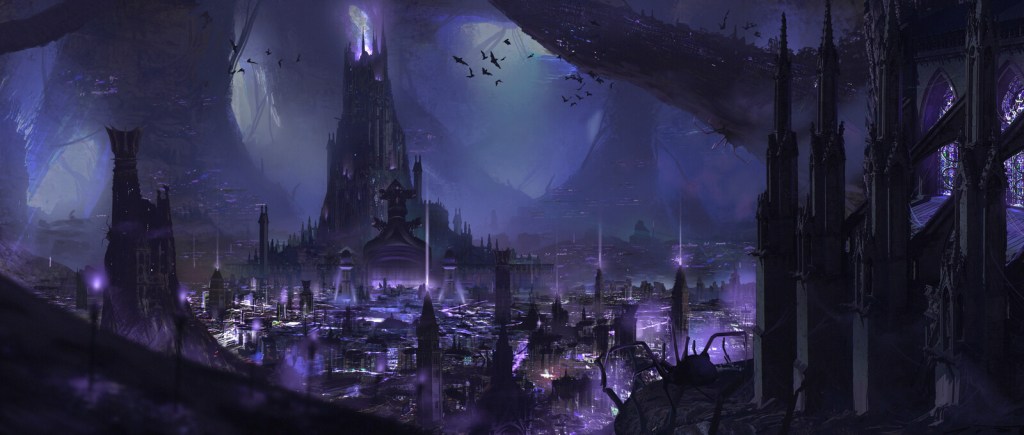
[Concept artwork by Andrew West, depicting the city of Menzoberranzan from The Legend of Drizzt – Animated Short]
INTRODUCTION
Sometimes, I do feel insecure about my taste in fiction. If people ask me what my favorite novels are, and if I wanted to look good, I’d list some books written by Ursula Le Guin, Catherynne M. Valente, Sarah Waters or Jeanette Winterson. But, in truth, the novels I find myself coming back to again and again are those I feel embarrassed to admit I like (at least, to people who aren’t my friends). For example, the Clan Novel Saga, a 13-books series of novels set in the world of Vampire: The Masquerade. The finale of the saga, Clan Novel 13: Nosferatu by Gerbod Fleming, especially stole my heart. The character of Calebros means more to me than words can inadequately express. Aside from that, the Tyrion & Teclis Omnibus by William King and the Van Horstmann novel by Ben Counter, set in the Warhammer Fantasy universe, are some books which brought me so much joy and fun and touched me in ways I did not expect them to.
What I want to discuss today, however, is my love for the Legend of Drizzt series by R.A Salvatore. Originally, I had planned to do a deep dive on Salvatore’s natal chart from the perspective of astrology and fixed stars (and trust me, Salvatore has a very, very spicy chart). But, the more I write, the more uncomfortable I feel making what is essentially speculation about a minor celebrity who is still alive and active. Hence, my goals shifted. This blog post will henceforth be an exploration of the fictional text and its characters rather than the life and personality of its author.
Naturally, THERE WILL BE SPOILERS up until Lolth’s Warrior, the latest book in the series.
There are two purposes to this blog post, split into two parts.
First, a self-indulgent fangirl-ish love letter to Gromph Baenre, my favorite fictional antagonist. Gromph may not be the ‘best’ villain or antagonist out there (at the top of my head, I’d say Hannibal Lecter or even the likes of Cersei and Jaime and Tywin Lannister are much more well-written), but it must be understood that the Legend of Drizzt is meant to be children’s entertainment— hence the lack of relative depth, comparative to other more critically-acclaimed novels. It is only as the novels kept growing and growing (thirty nine books have been written so far) that the writing became much stronger and more adult in tone. I am not arguing that Gromph is the best villain or antagonist out there, only that he is my favorite for reasons which are my own.
Second, is my own attempt to construct a partial natal chart for Gromph Baenre. This is something inspired by the ‘Storycery’ magic as pioneered by Sasha Ravitch, wherein a fictional character can be enlivened or made more concrete by crafting them a natal chart, among other methods. You can learn more about this via her “Black Mirror; Glass Door: Witchcraft for Storytelling & Storytelling for Witchcraft” talk at the 2024 Salem Witch Fest. For some context, I have completed and passed Chris Brennan’s Hellenistic Astrology course which has granted me a basic foundation in Hellenistic astrology. That is the perspective I am coming from in my astrological analysis, in addition to my understanding of the text 36 Faces: The History, Astrology and Magic of the Decans by Austinn Coppock. Nevertheless, I am not a professional astrologer, and this is just a fun exercise for me, so please be aware that my interpretations may be imperfect.
Finally, I know this is a departure from the kind of blog posts I usually write. Yet, the fixed star Castor is one of my closest stellar allies and Castor is a patron of storytelling, so this post is dedicated to him as much as it is written for me. I would also like to dedicate this post to and to thank my friends from the Underdark Discord server and the Gomp Banre fans (you know who you are lol).
I hope you have as much fun reading this as I did writing it.
PART ONE: THE LOVE LETTER
“Evil is a Point of View”: the Villainy of Gromph Baenre
Gromph Baenre, the Archmage of Menzoberranzan, is a dramatic and surly and formidable villain. He is old and experienced, powerful and ambitious. He is someone whom we first hear about — thus building the anticipation in our imagination — before encountering later on. And, when we do meet him, he is comically evil to the point where it is just funny how evil he is. This, in my view, is akin to the early episodes of Game of Thrones where we see Jaime push Bran out of the window and think to ourselves: Jaime, the sister-fucking, oathbreaking kingslayer who tries to kill an innocent child, clearly is a irredeemable bad guy. We too expect Gromph to be a bad buy, and boy does Salvatore deliver on his promise.
As typical of drow society, drow often fight each other for power and conflict between siblings is not uncommon. When Matron Mother Yvonnel is killed and Triel Baenre is forced to ascend to her late mother’s throne, Gromph wishes to manipulate the somewhat naive and underprepared Triel, but Quenthel — Triel’s little sister and confidant — stands in the way and is Gromph’s competition to gain Triel’s favor. Hence, Gromph tries to kill Quenthel multiple times, escalating each attempt until he finally gives up. Quenthel, hilariously, does not even suspect Gromph. She instead is focused on Triel and ends up murdering Triel and usurping her place as Matron Mother. From there onwards, Gromph and Quenthel’s sibling relationship continues to deteriorate.
Gromph shows no guilt in experimenting with and desecrating the late Yvonnel’s decapitated head, which he kept after her death. Quenthel, when she learns of this later on, is disgusted by him. Gromph works with an illithid to extract what remains of Yvonnel’s essence and memories. Under the order of Lolth, he tricks Quenthel into undergoing a procedure wherein the illithid — via its tentacles and such — imparts Yvonnel’s wisdom and experience into Quenthel. The procedure Quenthel underwent is suggested to be very painful and violating, implied to be akin to physical and psionic assault, something Gromph finds great sadistic pleasure in witnessing. In the coming years, Gromph would once again, under the commands of Lolth, force his wife (Minolin Fey, his wife at the time) to undergo the same procedure whilst showing no sympathy towards her discomforts.
To me, even if Gromph cannot disobey Lolth’s direct orders, the fact that he so gleefully went through with them really does disturb me.
On the topic of wives, Gromph does have a complicated relationship with his previous wife, Sosdrielle Vandree. On one hand, drow society is unlike ours and husbands are usually treated no better than tools to impregnate women with. Fathers do not get to raise their children, nor are most children even aware of the identity of who their birth fathers are. Gromph, due to his status and standing, is an exception to this rule. He gets to choose his own wife, and Sosdrielle Vandree was picked for her beauty and precisely because she lacked abilities in clerical magic (unlike a typical priestess of Lolth). Whatever Gromph’s feelings towards Sosdrielle, he liked her enough to model an altarpiece of Lolth after Sosdrielle’s visage. At the same time, when Gromph saw the arcane genius of his daughter — Liriel, who even inherited the same amber eyes as Gromph — he, without hesitation, proceeded to murder Sosdrielle just so he can gain the full custody, just so he can raise Liriel as he pleased.
In other words, Gromph is a wife killer, regardless of his intentions. He is not a good guy, not even by drow standards, especially not in a matriarchal society where a man killing a woman is one of the worst crimes.
There are other things too that make Gromph an enjoyable villain as well. Gromph, as we come to learn, is very vain. He wears a brooch of perpetual youth, one which grants him an eternal appearance of youthfulness (even if the novels do go back and forth on this at times). Gromph knows he is handsome and he has no qualms about reveling in it. He is always dressed head-to-toe in impressive garbs and elaborate robes, befitting his station and house. Yet, in a hypocritical manner, he looks down upon other preening peacocks type of characters whom he is surrounded by— Pharaun Mizzrym for one. The rivalry and bickering he has with Pharaun (who, morally, is no better than Gromph) is an enjoyable read.
Gromph is also arrogant and prideful, and isn’t above threatening others just to make them feel small or to get what he wants. There are so many scenarios I could use as an example here, but the one that came to mind immediately is when he threatened to turn Artemis Entreri — an assassin, and a very skilled one at that — into a toad and step on him should Entreri ever address Gromph again. It’s just so unnecessary as Entreri was just trying to engage in conversation and wasn’t even an enemy at the time. Entreri is a human and Gromph, like many drow, believe humans to be inferior to them. His racist attitude continues for a long, long while and is very prevalent when he has to interact with a diverse group of colleagues for the first time when he is forced to flee Menzoberranzan, and is persuaded to work with the surface dwellers to rebuild the Hosttower of the Arcane.
To sum up, Gromph — for the most part of the series anyway — is fun to read about, but clearly not someone who you would want to be around, not if you value your own life and wellbeing. Salvatore, especially in the earlier books, does not shy away from showing the cruelty Gromph is capable of inflicting upon others. In the earlier books, Gromph is very undoubtedly evil. If we view Drizzt and the Companions of the Hall to be the protagonists, then there is no question that Gromph is the villain and an antagonist of this tale.
But, of course, there is more to him than that.
“Neither Angel Nor Beast”: the Complexities of Gromph Baenre
It’s easy to see how Gromph ended up the way he is.
Drow society is unforgiving. One needs to be ruthless to survive, arguably heartless to thrive. Gromph Baenre was groomed to thrive, fated for success. As the firstborn son of the ruling First House of Menzoberranzan, Gromph has no choice but to be successful, to make himself useful, to gain power and cling onto power, to be relentless in the pursuit of status and ambition, and to maintain an image of being someone at the top of their game. From the moment he showed affinity for magic, there is no question that the son of Matron Mother Yvonnel Baenre — the uncrowned queen of Menzoberranzan — would become the Archmage of Menzoberranzan, the highest position a male wizard like him can ever hope to achieve.
Yet, by the time of the later books, Gromph is implied to be deeply dissatisfied and unhappy with his position. Kimmuriel and Jarlaxle even call him out on his apathy towards the war and the politics of Menzoberranzan, something he no longer cares much about. In certain novels, his position as Archmage of Menzoberranzan has also been compared to a leash or chain. Gromph’s position in drow society, despite how glamorous or coveted it may seem, is in truth a trap he cannot easily untangle himself from without major consequences.
Therefore, it makes perfect sense then that the one thing Gromph wants more than anything else is freedom.
His desire for freedom is never explicitly stated, but it can be seen in the actions he takes. Take Liriel Baenre, for example. Although some may argue that Gromph is merely trying to mold his daughter in his image, to make her a wizard like he is in some narcissistic extension of himself, I would instead argue that Gromph saw himself in Liriel and wanted to give Liriel the options he never had. As a woman, Liriel would be expected to become a priestess. Yet, Gromph saw Liriel’s affinity for the arcane arts and instead trained her to become a wizard. She sincerely was so excited to study at the Sorcere, until that very choice was ripped away from her— not by Gromph’s hand, but by the Matron Mother, who forced her to study the ways of the cleric instead.
So, what does Gromph do when his daughter’s future is stolen away?
Gromph gives Liriel a grimoire filled to the brim with information on portal magic, spells to summon a gate. He has been working on this grimoire for decades before then too, in preparation for a moment like this.
Of course, he makes claims that the “gift” of the grimoire is to keep Liriel indebted to him. Nevertheless, the grimoire’s intention is to teach her the ability to one day travel wherever she wished, to go wherever she wanted to, whether it be somewhere in the Underdark, or the lands above, or even in some other plane of existence. The symbolism of him giving his daughter the knowledge of how to travel, how to escape — how to be free — is very poignant and says a lot about his true feelings for Liriel. In Gromph’s words, with this knowledge, Liriel can travel “where no priestess can follow. Liriel realizes this too, that the “gift would give her greater freedom than she had ever enjoyed.”
I would argue that, in his own twisted way typical of drow society, he truly loves his daughter and wishes the best for her. He, due to the way he was raised, just lacked the emotional intelligence or language to express such a feeling. His love for her can be seen in the very first scene where Gromph encounters a very young Liriel. Gromph, curious about her, asks her if she could read. Liriel, a mere babe, a child without an understanding of the dangers of magic, moves towards a spellbook to try and read it. This caused Gromph to panic, cursing under his breath as he slapped a hand over her eyes to try and prevent her from seeing the arcane runes which could attack the untrained eye, causing terrible pain, blindness or even insanity. Even way back then, when he just learnt of the existence of his daughter mere moments ago, his fatherly instinct to protect his daughter from accidentally injuring herself was present.
When she grows into a teen, her relationship with Gromph seems surprisingly warm for what is expected of drow society. It is nothing like the relationship Gromph had with his mother, Yvonnel Baenre, who it was implied he tended to not get along with (him having a habit of angering and displeasing her), and for Yvonnel to have whipped him in the past (such punishments being the norm). Liriel isn’t afraid to crack blasphemous jokes, to make fun of the Lolth priestesses, in front of her father. Gromph too isn’t afraid to chuckle at her remarks, to banter with her, to spoil her and let her throw the weight of his name around if she ever needs to flex or intimidate someone.
Of course, their father-daugher relationship did not last.
Liriel had to flee the Underdark after an incident involving an artifact. Gromph, I believe, probably thinks Liriel is dead after the whole fiasco.
Along with the desire for freedom, some of the other unexpressed desires Gromph seems to have is the yearning for recognition, appreciation and security. In the section of the narrative where Lolth is seen to be creating the Demon Weave in an attempt to usurp Mystra’s Weave, Gromph could be seen daring to hope that — should Lolth become the new goddess of magic — he, the Archmage of Menzoberranzan, would be elevated in his position, finally shown the same respect that other female priestesses are given. After all, he is arguably the greatest drow wizard who has ever lived, and that is not an exaggeration. He has dedicated himself to the arcane arts and to Menzoberranzan, defending it at the risk of his life in the past. All he wanted was to be rewarded, to be recognized for his efforts and accomplishments.
Ultimately though, the Spider Queen cared not for him.
Gromph would lash out at Lolth in his first true act of rebellion by dispelling the Darkening, even if he chose to keep his involvement a secret and gave Drizzt the credit instead. Jarlaxle, his closest brother, was the only one to realize what he did and why he did it.
Below is a quote from Jarlaxle’s perspective regarding this:
“Gromph had dared to hope that Lolth’s move would elevate his standing, that he, as the greatest drow wizard of the age, as the greatest drow practitioner of the Art, would become more than a mere male in the matriarchal City of Spiders. That was Gromph’s error, Jarlaxle realized, and he nodded knowingly as he considered his brother. Poor Gromph had dared to hope.”
One could not help but feel sympathy and pathos for the poor villain when reading this. Is it so wrong for Gromph to hope to be treated better? Is hope such a foolish thing to feel?
All of this culminates in how Lolth ends up manipulating Kimmuriel who in turn (unintentionally) tricks Gromph into summoning Demogorgon. The lead up to the Demogorgon incident is interesting too. It began with Quenthel (again… Gromph and Quenthel really do not get along) threatening to blame him for a setback in the war. Matron Mother Quenthel not so subtly threatens to replace Gromph with Tsabrak Xorlarrin in his position as Archmage of Menzoberranzan. Naturally, Gromph freaks out. His “outrage” is a reaction to being “threatened” with the one thing his identity is based upon.
So what does he do when he is threatened?
He goes to try and summon up a greater demon to prove Quenthel wrong, to prove to Quenthel that he does indeed deserve the title of Archmage.
The reason the ritual summoning went wrong and he ended up summoning the greatest demon lord of all — the Demon Prince Demogorgon — was entirely Lolth’s doing. Lolth thus betrays Gromph, all to further her own goals. She uses him as if he is a tool to be used and discarded. She cares not that her action tears families apart, driving a wedge between Gromph and his sister Quethel. She cares not that in doing so, Gromph is forced to flee the city, to leave his home, to escape the consequences of the devastation he unknowingly was tricked into unleashing. It was a humiliating ordeal too: Gromph pissed himself in terror upon seeing the Demon Prince and nearly clawed his eyes out, maddened by Demogorgon’s terrifying visage. Quenthel, once she learns of what Gromph did, is naturally furious. To this day, their relationship remains unrepaired, something I wish future novels would address.
Gromph’s relationship with Triel, unlike the one he has with Quenthel, truly is beautiful (and heartbreaking, when you know that Triel dies by Quenthel’s hands, of all people). I know I’ve spoiled plenty by this point, but this is one bit of the War of the Spider Queen series that really, really tugged at my heart the first time I read it. I’m talking about that scene, the one where Triel saves Gromph. It’s predictable, you’ll see it coming, but damn does it hit you in the feels regardless. I won’t spoil details of that scene because the way it was written was just so poetic and heartwarming. Personally, I also believe that Triel’s death and Liriel’s exile from Menzoberranzan truly affected Gromph and made him a lot colder, now that he is bereft of two allies/family members whom he could place a semblance of care and trust in.
The final point I wish to make in this section is how I adore the fact that Salvatore writes in tiny details and quirks to humanize Gromph, to make him feel real and relatable. Gromph has a rat familiar named Kyorli, and he really does go through hell and back with that rat. The way Kyorli acts and ‘speaks’ is so cute too, and so is Gromph’s palpable fondness towards her. Gromph is also shown to have a sincere talent and love for teaching (which makes sense… the Sorcere, after all, is an educational institution and Gromph is its Headmaster). He isn’t afraid to reprimand the idiotic Masters who fail to summon rain to stop a raging fire which was about to burn down the city. Likewise, when he does meet a student with potential, Gromph does show interest in such things. This is evident in a scene where he is on a mission and is posing as a student and visits that student’s bedroom (it’s a long story), and he becomes distracted by the student’s research/homework, surprised by how the student is more smart and organized than he seems.
(I myself would have a heart attack if my mentor came into my dorm to read my messy notes without my knowledge, regardless if they liked what they read or not).
There are also the bits where we get glimpses into his childhood shenanigans (eg: sneaking wine to drink in the dorms, something students aren’t allowed to do but all college students do anyway). Several times in the text he is also depicted to be enjoying fine wine or brandy. Gromph, as expected of a noble from the First House of Menzoberranzan, is very cultured. His preferred method of relaxation is art— magically creating a glowing wall of artwork formed from shifting multi-colored lights. I found this to be quite endearing the first time I read it, especially when Quenthel is surprised at how content he seemed, and how peaceful the artwork appeared. For me, it is these kinds of seemingly pointless details that fleshes out a character, making them seem well-rounded with real hobbies and believable interests.
“I Want It, This Life”: the Redemption of Gromph Baenre
I have already alluded to how Gromph is forced to flee Menzoberranzan after the Demogorgon incident. The incident, as horrible and destructive as it is, is also a blessing in disguise for Gromph. It is in the process of rebuilding of the Hosttower and the subsequent bonds he forms with his colleagues that he is challenged to become a better person— literally, at least in the case of Catti-brie who asks him if he can “look beyond [his] own needs and desires and act for the benefit of others”. His redemption arc, if we could call it that, is a non-traditional one. He never truly apologizes for the harm he’s caused, such as his contributions to the War of the Silver Marches and the way he has been an enemy to the Companions of the Hall in the past. Likewise, somewhat surprisingly, no one else demands his suffering nor apology.
In the words of a friend from Discord: there is “a grace to it that you don’t always see in redemption arcs. Gromph doesn’t need to prove himself to be good. It’s enough that he’s no longer evil. We can give him space to learn and grow and benefit from friendship without insisting he rake himself over the coals for his past actions.”
Gromph, arguably, doesn’t so much become ‘good’ as much as he ceases to be ‘evil’. And that, in my view, is enough, especially in light of how swiftly his life was turned upside down, how sudden all of this was for him.
Throughout that moment onwards, Gromph would keep making decisions after decisions that would firmly place himself in the position of being Lolth’s enemy. Yet, Gromph still struggles to admit any feelings towards his allies, something one of his colleagues definitely picked up upon. When asked by Caecilia — a fellow mage of the Hosttower — if he is concerned about his other allies, Caecilia notes how it’s “such a drow thing to say” when Gromph replies callously to her inquiry. She continues to press him, questioning if he would even care if all of the city other than those he deem valuable were to be slaughtered. Gromph retorted back, asking her if he should even care. It was then that Caecilia realized that she actually didn’t believe Gromph.
“Had he been so battered by the distorted culture of Menzoberranzan that he thought it a sign of great weakness to admit compassion? How many others? […] How many other dark elves had been similarly broken?
The quote above, for me, really hammers home the main theme of the series.
The cycle of trauma. Nature versus nurture. The effect growing up in an oppressive society has on one’s psyche.
Perhaps, this is why I truly cling to Gromph as a character: he represents to me how one could be shackled by their status, trapped in a golden cage that in truth is not so much a mere cage but an iron maiden. The cage isn’t a prison, but a torture device, skewering wounding whatever is caught within it.
Yet, wounds do heal.
Freedom is possible. Rebellion is possible. Escape is possible. Change is possible.
Redemption is possible, even for one as vile as Gromph.
Later on, after Gromph adjusts to the functionings of the Hosttower and the fact that he does not have to be a tyrant to command respect, that he can just hear other people’s opinions out and everything will still be okay — horizontal teamwork and management rather than a vertical one — he really does drastically change. Even Catti-brie is surprised by this: “the fact that he was even allowing the ethical implications of fashioning a new spell at his table was something the Gromph Baenre she had first met would never begin to consider.” Still, she also notes that Gromph’s ego still “bristled at any thoughts of emotional softness”, that even after everything, he “was trying to show her that he was still that hard-hearted and merciless grand wizard from Menzoberranzan”. So, it seems, there are still habits and behaviors that Gromph still struggles to discard, such as his need to perpetually appear powerful and intimidating, a survival mechanism that would take decades to unlearn.
This, for me, is a very realistic depiction of trauma survival. Even when you are in a safe space, it is not easy to let go of all the things that helped keep you alive until then.
Nevertheless, Gromph is still Gromph. He never loses that edge that makes him the ambitious man that he is. Gromph, away from the prying eyes of Catti-brie and others, has been working on a way to achieve immortality without resorting to lichdom. He figures out a way to extend his lifespan by creating younger clones of himself which his soul would inhabit after the current body of his dies for whatever reasons. This makes perfect sense to me, for Gromph is very old, even by drow and elven standards. Yet, it is only in the past few years — not even decades, years — that he is able to live a life somewhat free from the influence of Lolth.
Perhaps, that is why he is so eager to extend his life: not necessarily out of the vanity of youth as one might expect— but because he wants to live.
He wants more time to truly live, to experience life and taste true freedom.
I have to end this section of the blog post by discussing the utterly, indescribably beautiful metaphorical and literal rebirth of Gromph Baenre.
This will be major, major spoilers for the ending of Lolth’s Warrior. You have been warned.
In Dungeons and Dragons, alignments — good and evil, chaos and order — are not just moral philosophies. They are a tangible and fundamental force of the universe. Should an angel cease to be good, for example, then it would no longer be an angel. In Lolth’s Warrior, this concept is explored wherein Gromph is shown to be unable to attune to his old black robes, the one which represented his station as the Archmage of Menzoberranzan. The robes, if it to be properly attuned and be more than a mundane piece of cloth, requires the wearer to uphold certain mindsets and worldviews in order to wear it. In the case of the robes of the Archmage of Menzoberranzan, Gromph has to be evil: selfish and cruel, everything the Archmage of Menzoberranzan is expected to be.
In contrast, Gromph can now successfully attune and wear the gray robes representing his status as the Archmage of the Hosttower. The gray is symbolic of neutrality: we see glimpses of this in the past, when Gromph initially refuses to have the Hosttower take a side in the conflict of the drow. Gromph explains to Catti-brie that the robes “are extensions of the being wearing them, an amplification of the wizard’s heart and soul”. This, therefore, implies a significant shift in Gromph’s “heart and soul”. In technical terms, this represents his shift away from evil and towards neutrality.
But that isn’t what shook me.
Long story short: an avatar of Lolth is in Menzoberranzan, and Gromph has a plan to destroy it. For this mission, he chose to wear his black robes, the ineffectual robe of the Archmage of Menzoberranzan. He also adorns himself with all kinds of artifacts and enchanted jewelry, and brings with him to battle the Staff of Power. Then, when he comes face to face with Lolth’s avatar, he allows himself to be attacked, to soak up all the magical damage from the wizards hurling spells at him. As planned, the Staff of Power and the artifacts and jewelry and such becomes overloaded and explodes— taking out Lolth’s avatar and Gromph along with it.
Gromph doesn’t die. He did not know if his plan would succeed or not, but it did and he reappeared in his younger, cloned body. His experiments in search for a form of immortality was a success and, along the way, he gets to perform an act of direct and major rebellion against Lolth.
(Did you see the symbolism?)
(I did: I almost cried the first time it hit me.)
Gromph rebels against Lolth and allows himself to die, to be burnt to ashes, all the while he is wearing his old black robes of the Archmage of Menzoberranzan.
Gromph allows his old self to die. He — finally, after all this time — lets go of his identity as the Archmage of Menzoberranzan, allowing himself to be reborn into something new.
I don’t know who exactly is my target audience for this part of the blog post. But, if my witchy friends are reading this, then you understand how important the concept of death and initiation and rebirth is to witchcraft. I can’t say that I’ve gone through a particularly dramatic death: my personal experiences feel more like a shedding of skin, and a bestowal of fire to empower the ‘new’ me. If anyone cares to read it, I’ve written something about my experience asking Hydra to help me be reborn in Her image in a blog post titled “In Search of Pleasure: A Venus Retrograde Journey”. The ritual consists of the use of fire and ashes and burning an image of oneself, which is why reading that scene in Lolth’s Warrior of the manner in which Gromph is ‘reborned’ really struck a chord with me.
R.A Salvatore has stated that he does not have any plans yet for any new novels. I hope he does continue with the series because there is still so much to explore. But, in the unlikely and unfortunate case that Lolth’s Warrior is the last novel in the series, I am nonetheless very happy with the poetic and beautiful ending Gromph received.
PART TWO: THE NATAL CHART
Moon in Capricorn III
One of the clearest things that jumped out at me is how Gromph Baenre must have a Moon in the third decan of Capricorn. This is partially because R.A. Salvatore himself has a Capricorn Sun in the third decan (in contrast to Gromph’s Moon) and I do believe oftentimes there are fragments of the author in the characters they create, but I also chose this placement because of how perfectly suited this decan is for Gromph.
Whereas the Sun is considered to be the ruler of the third decan of Capricorn, the Moon in Capricorn, on the other hand, is struggling in detriment via essential debility. The Moon usually relates to the ‘mother’ and an ill-placed moon like this may indicate mother-related wounds. With Gromph, two mother-figures — Yvonnel Baenre and Lolth — had failed him. We’ve discussed Lolth’s treatment of Gromph aplenty already, so I won’t repeat what was previously said.
However, it is worth exploring the manner in which Gromph handles his mother’s corpse. Instead of allowing her to rest, Gromph hangs onto his mother’s decapitated head. This is a very fascinating symbolism, considering that in many cultures, the head is the dwelling place of the soul. Moreover, Gromph forces his mother to live on, almost forcing her to continue to metaphorically haunt him and his family: first, via his sister, Quenthel, then, via his daughter, Yvonnel the Second. Quenthel, after receiving the wisdom and experiences of Yvonnel the First, begins to take on some of her mannerisms and quirks, something which unnerves Gromph greatly. Yvonnel the Second is a much more extreme version of this: a toddler girl, reminiscent of the abomination Alia Atreides, who grows up much too quickly due to the thousand years of memories no child should possess.
Gromph clearly has mother issues and issues of matrilineal hauntings, and I believe a Moon in Capricorn represents this well. This is especially true if we are to place it in the eighth house (which also happens to be the house of R.A Salvatore’s Sun), the house usually associated with death and the occult and inheritances.
Then, there is the decan itself. According to Austin Coppock in his book 36 Faces, a Moon in Capricorn III “makes for natives emotionally beholden to power structures. They are responsible, but often to their own detriment, and many are thrust into burdensome positions too early in life. So beholden, they may ignore their own needs in light of the demands their position makes upon them.” This, in my view, fits Gromph to a tee. Gromph is chained by the structure of his society and the role he plays in it, situated at the very upper echelon of that hierarchy which chains and constrains him. He only experiences true joy and freedom after escaping from the power structure of Menzoberranzan and the Lolthian drow society.
Sun in Taurus III
As for Gromph’s Sun, I have ruminated around many sign placements for him and what I ended up with kind of surprised me too. Gromph, to me, seems to have a Sun in the third decan of Taurus . Taurus, much like the bull, is known for its stubbornness (or some might say bull-headedness), its reluctance to change (for it is a fixed earth sign), for its slowness (such as, in Gromph’s case, having the patience and diligence to make plans which may not pay off until centuries later). Although Gromph does change and openly rebel against Lolth in the end, if one looks at the timeline of how long it took for him to finally do so… Gromph was born in 670 DR and the events of Lolth’s Warrior wasn’t until about 1491 DR. That’s over eight centuries— a long time, even for one with an elven lifespan.
Yet, the change can be seen ruminating, occurring over increments over the centuries. It was no secret in Menzoberranzan that Gromph was not the most devout of Lloth’s followers. During the War of the Spider Queen, Gromph was given the opportunity by the Lichdrow Dyrr to essentially stage a coup over Menzoberranzan, to do away with the old order — with Lolth entirely — and although Gromph rejects this opportunity out of fear and hesitancy and the desire to cling to his status as a Baenre, the fact that he even entertains the notion does show his desire for change. Then, came the first act of rebellion where he dispelled the Darkening. Then, he is forced to flee Menzoberranzan after summoning Demogorgon, and once he becomes the Archmage of the Hosttower, his allegiance to Lolth is tested again and again, until he finally decides to oppose her openly. In other words, his character growth is a slow but steady one. His decision to rebel against Lolth might seem to some readers sudden and surprising, but it’s not sudden at all if one considers Gromph’s perspective. Such is the way Taurus moves: slowly, with the understanding of weight and intention.
Moreover, Taurus is a sign ruled by Venus, and we have touched upon Gromph’s fine taste for liquor and art in the earlier section of the blog post. This does match what Austin Coppock has observed in his podcast episode, The Signs of the Zodiac: Qualities and Meanings, about people with Taurus-heavy charts. To those individuals, the cultivation of taste and value is very important. Once they’ve been exposed to a certain level of cuisine or art or become accustomed to a certain lifestyle choice, they won’t accept anything beneath that. And, as we can see, Gromph certainly has a fine taste for luxury that gets shown repeatedly throughout his story arc, even after he’s left Menzoberranzan, probably due to his exposure to luxury in his youth. Likewise, Gromph’s vanity regarding his appearance — how he is “keenly aware of the impressive picture he made”, that he “knew he was striking even without the trappings of power” — is also a very Venusian trait.
Further still, Taurus is about wealth and the various ways we define wealth. And wealth, and the many forms it takes, is a resource which the more you have, the more power you hold. Ergo, Taurus too is about power. I don’t think I have to elaborate on why ambitious and power-hungry Gromph fits this delineation.
When considering what decan his Sun in Taurus may dwell in, the third decan of Taurus is one which makes perfect sense for him. Below is a quote from 36 Faces:
“In this face the light of the Sun illuminates a struggle between hubris and humility, disaster and recovery. Those born with their Sun here have their character tested and shaped not only by events but by their response to them. Due to the nature of this decan, some of the natives are suspicious, even paranoid, assuming the worst is right around the corner. Yet they are also privy to the secrets of both personal redemption and collective recovery. Their success and character, in large part, depend on their ability to remain humble before the world’s great forces, yet remember that although they are not in control, they are far from powerless.”
Hubris and humility is a theme of Gromph’s arc regarding the Demogorgon summoning. Lolth only did what she did, and Kimmuriel only did what he did, because they believed they could take advantage of Gromph’s arrogance and use that against him. To Kimmuriel, Gromph was hubristic enough to believe that he was the first drow to ever consider blending the psionic arts with the arcane arts. To Lolth, Gromph was prideful enough to dare to summon a demon greater than any that his peer has ever summoned, which is what enabled him to be tricked into letting loose the most fearsome Demon Prince of them all. What comes after is a disaster of a tremendous magnitude. What he inadvertently unleashed is chaos beyond his control. This incident turns his life on its head, forcing him to flee the only home he has ever known, to start anew— the “recovery” associated with Sun in Taurus III. Personal redemption follows, as previously discussed. All the while, Gromph’s paranoia — cultivated over centuries of having a target on his back — never really goes away, which is why he still struggles to let his guard down and show vulnerability.
Additionally, the third decan of Taurus lies the fixed stars of Capulus and Algol, the stars of Perseus and Medusa. Decapitation and violent death is a theme with both of these stars. Decapitation makes sense because of the whole debacle regarding Gromph and his experiments with Yvonnel’s decapitated head. And whilst violent death honestly could be applied to the whole of drow society and politics, it does fit Gromph’s fate and the fact that he almost died violently many times, narrowly escaping death each time, before finally choosing to willingly undergo a violent death, one which then leads to what could be described as a spiritual (and literal) death and rebirth— I could interpret all of this via the witchcraft perspective of initiatory death, but I’ll refrain from doing so. Those who already ‘get it’ will not need to hear anymore of my ramblings.
Mercury in Virgo II
The planet Mercury is one which I believe is influential in Gromph’s chart. Mercury, according to the Picatrix, is associated with diverse sciences, subtlety, intellect, divination, and teachings. As a wizard and a schemer and someone who experiments with magic and a man who was once in charge of a wizarding school, Mercury would very much act as a patron of Gromph’s profession. Mercury’s association with divination is also fascinating too, as those who have read the War of the Spider Queen may know, Gromph is an extremely skilled scryer. In the 3.5th edition of D&D, Gromph is also stated to be a diviner of 16th level, which is really impressive too. Building upon this, in traditional astrology, Mercury is said to have essential dignity via domicile in the sign of Virgo. This is why I believe Gromph has a placement of Mercury in Virgo. More specifically, a placement of Mercury in the second decan of Virgo.
This decan of Virgo expands upon this theme of wealth. The Picatrix states that this is a face “of desires, and of wealth, of tribute,” while Agrippa writes that it signifies “gain, scraping together of wealth and covetousness.” Coppock also states that “those born while the messenger is here are blessed with thorough, analytical minds. They have a talent for thinking through a process from start to finish and thus many excel at laying plans. They are critical of others’ opinions, and prefer facts to visions. If Mercury is not overly impeded, their intelligence is easily applied to both academic subjects and business matters.”
All of this suits Gromph, due to the way he covets resources and power, and his keen intelligence as required of an Archmage. He is a planner and schemer, and often is critical of those he believes are beneath him. Even the tidbit about how those with this placement may apply their intelligence to business matters also rings true. There is a scene in the novel Boundless where Gromph negotiates with Jarlaxle to have Jarlaxle pay him an expensive fee for a service. I doubt Gromph actually needed the money, but the fact that he still pushed for Jarlaxle — his brother in blood if not name — to pay really does give that shrewd business acumen associated with the Mercury in Virgo II placement.
The second decan of Virgo also lies the fixed stars Denebola and Zosma. Zosma represents the place on the back of the Nemean Lion where the latter was crushed by Hercules. Bernadette Brady, in Brady’s Book of Fixed Stars, states that the star Zosma is associated with “those whom the establishment, either directly or indirectly, makes powerless. Generally it does not belong in the charts of the rich and famous, unless they become so victimized. It is present in the charts of victims, of people who are abused by the system. It is not an “evil” star, but its presence means that the particular planet with which it is connected will potentially be abused in some way.” Drow society under Lolth, in my view, is inherently abusive. It does not mean that all drow are evil, merely that the structure of the system that Lolthian drows are raised in encourages an atmosphere of oppression and cruelty. Gromph, despite his power and status, is still subjected to the same abuse that many other male drow endure.
“Many times have I bowed to women— to do otherwise was to feel the bite of a snake-headed scourge.”
Zosma, should it show up in Gromph’s chart, would exemplify well this aspect of the drow society under Lolth.
Additional Fixed Stars
This section of the post is primarily written for the fixed stars witches and astrologers.
For fun and sheer curiosity, I decided to check the timestamp on Google Documents of when I first started writing this blog post. The stars present include Markab right on the ASC, Aculeus and Lesath on the MC, Denebola on the DSC, and Alnilam on the IC. Likewise, on the natal horizon are a shitload of stars: Phact, Alpheratz, Alnilam, Aculeus, Zosma and Ras Alhague. There is also a hearthstone paran of a Mars-Algol present too. Needless to say, all of this — the appearance of Algol and Zosma (and Denebola) especially — made me feel very vindicated on my choice of placements of Gromph’s Sun and Mercury.
The appearance of the stars of Pegasus and Scorpius did not surprise me. Pegasus and his stars, Alpheraz and Markab, are all about freedom. Bernadette Brady states that Alpheratz is “linked to freedom, love of movement, speed, and the sheer joy of the wind in one’s hair.” Freedom, as discussed previously, is the one thing Gromph truly desires. For those interested in reading about the stars of Pegasus in relation to the film Mad Max: Fury Road, I’ve also written a blog post about that.
The appearance of the Stinger Stars of Scorpius — Aculeus and Lesath — also does not surprise me. I initially was expecting something like Antares for Gromph, but Aculeus and Lesath makes sense too. R.A. Salvatore himself similarly has the star Acumen as his heliacal rising star, which hearkens back to my theory that authors of characters often put fragments of themselves into their creations. Aculeus and Acumen are also associated with spiders, as expanded upon in the pamphlet “The Red Dreaded Spindle” by Sasha Ravitch. Spiders, likewise, are obviously connected to Lolth, the Spider Queen, whose capricious cruelty is integral to the characterization of Gromph and the drow society which he grew up in.
What surprised me though is Alnilam’s appearance on the IC and the natal horizon. Alnilam is a star of Orion, and I would encourage those interested in learning more about Orion to read Maeg Keane’s article “Orion: A Winter Pile of Blood and Muscle” on their substack. Either way, I’m inclined to dismiss Orion as being related to Gromph. The star’s appearance in this context probably says more about me — the author of this post and my feelings towards Gromph — more so than the character itself.
CONCLUSION
TL;DR I really, really love Gromph Baenre and praise be to R.A. Salvatore (and Elaine Cunningham) for writing such an enticingly fascinating character!
Gromph is a fan favorite, not neccessarily because we agree with him, but because many of us sees ourselves in his complexities. A part of why I love Gromph’s characterization so much is because his tale is really is one of how people are shaped by their environment, and how much they can change once they escape the oppressive/abusive space. Gromph’s tale, now that he is freed from Lolth and has carved a life for himself out upon the surface world, is just filled with potential. That’s the most wonderous and exciting part: the unlimited potential of where he might go from now.
It was a fun exercise to try and assign astrological placements to a fictional character like this. I must admit to have ‘cheated’ somewhat by using the Thoth tarot card (which has astrological placements on them), along with the aid of a spirit of the fixed star Castor, to help me decide where Gromph’s Sun and Mercury should be. Still, the fact that my choices were vindicated via the appearances of fixed stars like Algol and Zosma (and Denebola) is also really, really cool.
Edit: 9/7/2024
I would like to add something else that feels significant, but it’s also something I don’t have the mental capacity to fully expand upon right now. It’s the fact that, just like how George Miller may have unintentionally written an eco-feminist tale when he created Mad Max: Fury Road, I believe R.A. Salvatore may have created something of a feminist deconstruction in the Legend of Drizzt. Whenever I read about the society of the Lolthian drow, I find myself recognizing within it echoes of the real world’s patriarchy— albeit turned upon its head, a matriarchy rather than a patriarchy, and exaggerated as all fictions tend to be.
Gromph’s experience as a male drow — a very skilled drow, at the top of his area of expertise, in a society dominated by women — echoes very much the experience of being an in-real-life woman within a male-dominated field. Any woman reading this will probably have experienced the frustrations of being ‘mansplained’ by someone before. More than that, I wouldn’t be surprised if many women understand the rage we feel whenever we have to hold our tongues around men who may be our superiors in the workplace, in order not to bruise their egos. Gromph, too, suffers from similar predicaments. To speak out of turn means facing the threat of being whipped, even (or especially) at the hands of his own mother and sister. He thus has to learn how to play them, how to get them to listen to him, because simply voicing his thoughts is not enough.
There have also been instances in the text (although I cannot recall which books exactly) where it is implied that Gromph sometimes wonders how his life may be different if only he were a woman instead of a man. This very much reminds me of how Cersei Lannister frequently says that she wishes she had been born a man instead of a woman.
What I’m trying to say is that, Gromph really makes me feel seen with regards to my own experiences with gender-based discrimination. That, among countless other reasons, is why I love his characterization so much.
 Upon the Altar
One response to ““How Many Others?”: A Love Letter to My Favorite Fictional Antagonist”
Wow… This was amazing! I truly love this grouchy, old bastard for all of the reasons that you went over! So many tiny, little things that had me quirking my eyebrow going, “Oh, I see you. I see the light through the cracks of your darkness. You are not a good person as you are now, but that doesn’t mean there aren’t parts of you screaming out, muffled and choked by pain, duty and circumstance. Perhaps you will never truly be a good person, but that does not mean that you at your care are evil.” So many points I time I threw the books on my bed squealing, “THAT’S MY BOY! THAT’S MY ARCHMAGE! FUCK YEAH!” whenever these little traces of ‘humanity’ for a lack of a better term for it started to show through.
There was even a brief passage where he thought of Sosdrielle and regretted killing her in Windwalker, around page 170-ish
—-
The priestess responded with a brilliant smile. Gromph noted, to his
great surprise, that she had become attractive. Not beautiful, as Sosdrielle
Vandree had been, but few drow could matched Liriel’s mother for beauty,
not even her daughter.
He felt a rare twinge of regret, an emotion quickly banished. He had
not thought of his long-time mistress for many years.
Shakti waited politely. Gromph realized that he was staring. “Why
do you delay?” he snapped. “You have been dismissed.”
—-
Part of me thinks that under different circumstances, Gromph might have been able to fully love Sosdrielle. I genuinely I think he was capable of truly loving her. But in the circumstances that Menzoberranzan forces upon her citizens, he only cared for her as much as he dared to allow himself to.
Seeing someone begin to work through all the shit they’ve been through, where there are still traces of good deep down that shine through every now and again, however faintly, is truly wonderful. I can’t help but wonder what kind of man Gromph would have been had he been born on the surface.
LikeLike